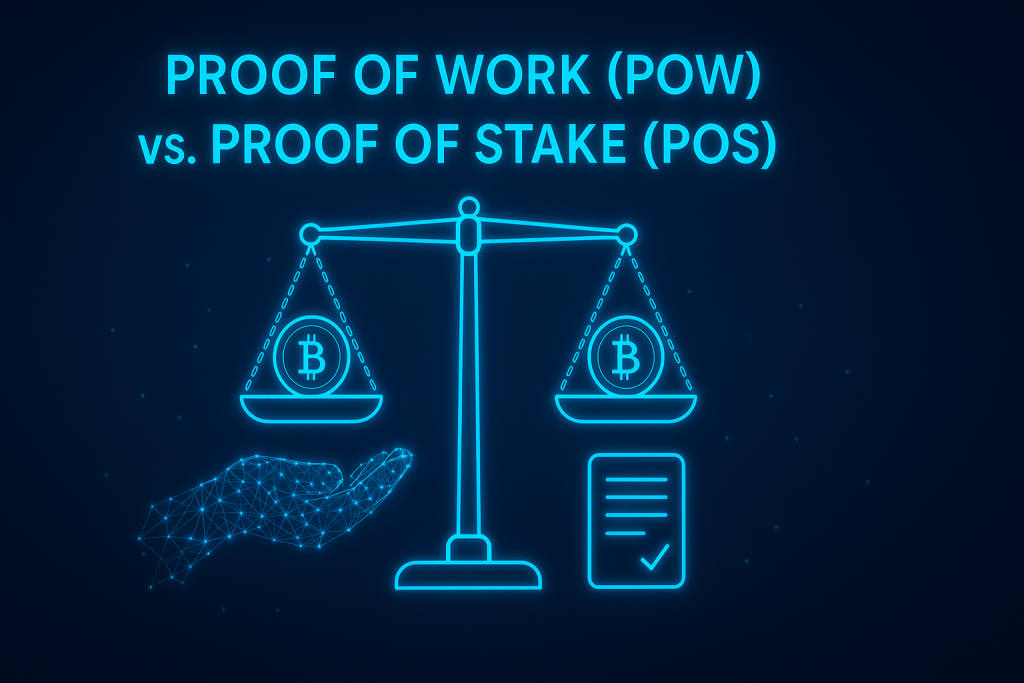
1. Proof of Work (PoW)
PoW secures the network by requiring miners to expend real-world effort (work).
| I. Analogy | The Great Race. |
|---|---|
| II. How it Works | Miners compete globally, using powerful computers and electricity, to solve a complex math puzzle. |
| III. The Winner | The first miner to solve the puzzle adds the next Block and is rewarded with new crypto. |
| IV. Security | Security is based on the high cost of energy and hardware, making cheating impractical. |
| Examples | Bitcoin (BTC), Litecoin (LTC). |
2. Proof of Stake (PoS)
PoS secures the network by requiring participants to put up financial collateral (stake).
| Analogy | The Weighted Lottery. |
| How it Works | Validators lock up (stake) their coins. The network randomly selects a validator (based on stake size) to create the next Block. |
| The Winner | The selected validator is rewarded with transaction fees. |
| Security | Security is based on financial collateral. Cheaters are punished by having their staked coins taken away (slashed). |
| Examples | Ethereum (ETH), Cardano (ADA), Solana (SOL). |
3. Key Differences in a Glance
| Feature | Proof of Work (PoW) | Proof of Stake (PoS) |
| Main Resource | Energy and Hardware | Crypto Ownership (Financial Stake) |
| Environmental Impact | Very High | Very Low (Highly energy-efficient) |
| Transaction Speed | Slower (~10 mins/Block) | Faster (Can be seconds/Block) |
| Barrier to Entry | High (Expensive hardware) | Lower (Requires crypto stake and software) |
Leave a Reply