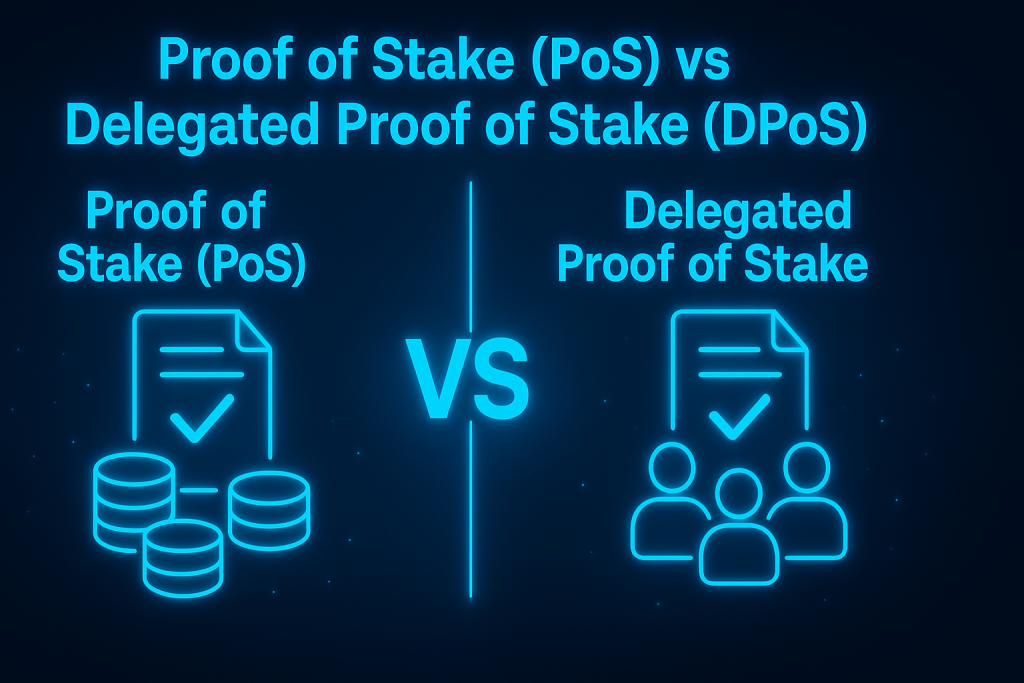
The core difference between Proof of Stake (PoS) and Delegated Proof of Stake (DPoS) lies in the role of the user: In PoS, you directly validate; in DPoS, you vote for someone else to validate.
1. Proof of Stake (PoS)
| Feature | Analogy: The Lottery with Extra Tickets |
| Mechanism | Users lock up (stake) their crypto to become Validators. |
| Selection | The network randomly selects a Validator to create the next block; a larger stake gives a higher chance of selection. |
| Participation | Users secure the chain directly (by running a node or joining a pool). |
| Security | If a Validator cheats, their staked funds are slashed (taken away) as a penalty. |
| Examples | Ethereum (ETH), Cardano (ADA). |
2. Delegated Proof of Stake (DPoS)
| Feature | Analogy: The Digital Democracy |
| Mechanism | Token holders vote to elect a small, fixed number of trusted Delegates (or Block Producers). |
| Selection | Only the handful of elected Delegates are responsible for creating blocks in a scheduled order. |
| Participation | Most users participate indirectly by delegating their voting power to a chosen Delegate. |
| Accountability | If a Delegate misbehaves, the community can quickly vote them out. |
| Examples | EOS, TRON (TRX). |
3. Key Differences Comparison
| Feature | Proof of Stake (PoS) | Delegated Proof of Stake (DPoS) |
| How Validator is Chosen | Randomly selected by the algorithm based on the stake amount. | Elected by the community through voting (stakeholders delegate power). |
| Number of Validators | Very High (Thousands of potential validators). | Very Small and Fixed (Usually 20–100 elected Delegates). |
| Transaction Speed | Fast (can slow with high validator count). | Very Fast. Small, fixed group allows for high efficiency. |
| Decentralization Risk | Lower risk; participation is open to anyone with the minimum stake. | Higher risk of centralization as only a few elected delegates control block production. |
Leave a Reply